
How Civil Engineering and Mechanical Engineering Work Together on Complex Projects
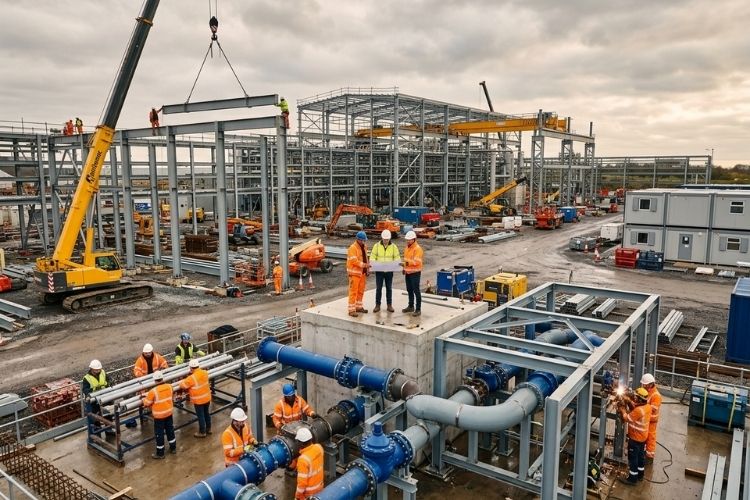
Large-scale industrial and commercial projects are rarely the domain of a single engineering discipline. From the foundations in the ground to the pipework and machinery installed above them, successful project delivery depends on civil engineering and mechanical engineering working in close coordination. When that coordination breaks down, the results can be costly: delays, rework, budget overruns and safety risks. When it works well, the result is a seamlessly delivered project that meets the client’s requirements on time and within budget.
Understanding the Two Disciplines
Civil engineering covers the design, construction and maintenance of the built environment. On an industrial project, this typically includes groundworks, foundations, concrete structures, drainage, roads and infrastructure. Mechanical engineering, by contrast, focuses on the design, fabrication and installation of machinery, pipework, structural steelwork and plant equipment. Both are essential, but they operate across different phases of a project and involve very different teams, skills and sequencing requirements.
Where the Two Disciplines Intersect
The interface between civil and mechanical engineering is where projects most often encounter difficulties. Key areas where the two disciplines must be carefully coordinated include:
- Foundation design. Civil engineers must design foundations that account for the loads imposed by mechanical plant and equipment. This requires detailed input from mechanical engineers before groundworks begin.
- Pipe and cable routing. Pipework, conduits and cable routes must be considered during the civil design stage to avoid costly penetrations and modifications once structures are in place.
- Structural steelwork integration. Platforms, walkways and pipe support installed by mechanical teams must be integrated with civilly constructed slabs, walls and frames.
- Programme sequencing. Civil works must reach the right stage of completion before mechanical installation can begin. Poor sequencing is one of the most common causes of project delay.
The Advantage of an Integrated Contractor
One of the most effective ways to manage the interface between civil and mechanical engineering is to appoint a single contractor with genuine capability in both disciplines. When civil and mechanical teams sit within the same organisation, they share information freely, raise clashes early and make decisions collaboratively. There is no blame culture between separate contractors and no time lost waiting for one party to respond to another.
At Stocks Group, this is precisely what we offer. Through our group companies, we bring together civil engineering and construction expertise via Scotton Construction and structural, mechanical and pipework engineering via Site Service Engineering. Both businesses operate under the same values and management structure, which means our clients benefit from genuinely joined-up delivery across both disciplines.
Proven Across a Range of Sectors
Stocks Group has delivered integrated civil and mechanical engineering projects for clients across the steel, petrochemical, energy, recycling and infrastructure sectors throughout Lincolnshire, Yorkshire and the East Midlands. Our experience of managing both disciplines on a single site means we understand exactly where the pressure points lie and how to manage them proactively.
Talk to Stocks Group
If you are planning a complex project that requires both civil and mechanical engineering expertise, we would be delighted to discuss how Stocks Group can help. Our integrated approach reduces risk, improves programme certainty and gives you a single, accountable partner for the full scope of works. Get in touch with our team today.